The advice everyone gets first
Mention leakage, pelvic heaviness, or post-baby weakness to nearly any clinician and the first recommendation will be kegels. The reasoning is sound: the pelvic floor is muscle, and muscle responds to exercise. But the gap between that theory and what happens in real bodies is large. Many people do kegels for months, see no change, and conclude the problem is permanent. It is not. The standard prescription is incomplete, and so are most of the products sold to supplement it.
Most people cannot isolate the right muscles
Biofeedback studies show that a substantial share of women, sometimes a majority, perform kegels in a way that works the wrong muscles: squeezing the glutes, bracing the abdomen, holding the breath, or bearing down instead of lifting. Without feedback there is no way to know. Biofeedback trainers and apps help with this, and it is their best feature, but they still depend on you producing the contraction correctly, every time. A device measuring a contraction you are not really making does not close the gap.
Even correct kegels reach only a fraction of the floor
The pelvic floor is not one muscle but a layered group: levator ani, coccygeus, the perineal muscles and the fascia around them. Voluntary contractions recruit the superficial fibres under conscious control. The deeper layers, which contribute most to bladder support, are not fully wired into voluntary recruitment. And even a perfect kegel produces a contraction at a fraction of the muscle\'s potential output. Real remodelling needs sustained high-intensity work that voluntary effort cannot supply, which is why disciplined patients plateau at a modest improvement and the rest see nothing.
The consistency problem
At-home programmes also live or die on adherence. Real change takes daily, sustained effort over months. The app reminders get dismissed, the weighted trainer ends up in a drawer. That is not a character flaw; it is how almost everyone behaves with a tedious daily exercise that gives no immediate feedback. A treatment that does not depend on your daily discipline has a built-in advantage for actually working.
What at-home trainers and apps can do
None of this makes them worthless. For a motivated person with a mild issue and good muscle awareness, a trainer or app can genuinely help and is a reasonable first step. They can also serve as maintenance after in-office treatment. The honest framing is matching the tool to the severity and to the person, and being clear when the gap between voluntary effort and what the pelvic floor needs is too large to close alone.
What pelvic floor physical therapy does
A pelvic floor physical therapist assesses the muscles directly and works out whether they are weak, too tight, poorly coordinated, or all three, then builds an individual programme: teaching correct contraction, releasing overly tense muscle, biofeedback, and retraining how the floor works with breathing and the core. Its strength is individualisation, and its reach into coordination and tension problems that a strengthening device alone cannot touch. For pain-driven or dysfunction-driven cases it is the right tool.
What Emsella does differently
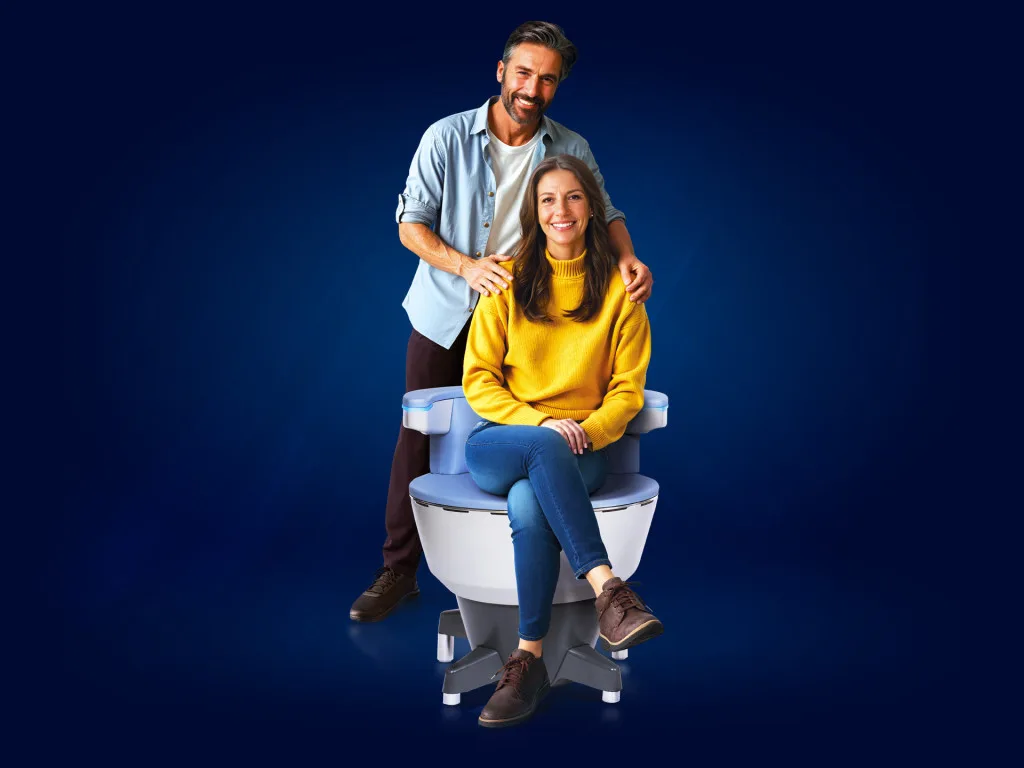
Supramaximal contractions are stronger than the nervous system normally allows; the brain limits voluntary recruitment as a safety mechanism. Focused electromagnetic energy bypasses that limit by stimulating the motor neurons directly, engaging close to the whole muscle, deep layers included. A single 28-minute Emsella session delivers roughly 11,000 of these contractions while you sit fully clothed. That is more pelvic floor work than months of faithful kegels, it does not depend on your form, and the protocol is six in-office sessions rather than a daily habit sustained alone. Voluntary control usually improves alongside, because the nerve pathways are being re-educated.
When to lean toward each
Lean toward physical therapy when the problem involves pain, muscle tightness, poor coordination, or a complex history that needs hands-on assessment. Lean toward Emsella when the main problem is weakness and stress-type leakage, when you have tried kegels or trainers without result, or when a clothed, no-effort, no-homework treatment is what will keep you consistent. Many patients choose Emsella precisely because adherence was their sticking point.
Why it is often not either-or
These approaches work best together more often than they compete. Emsella rapidly builds strength and re-educates the neuromuscular pathways; physical therapy addresses coordination, tension, and the functional patterns that keep the improvement. For someone with both weakness and coordination issues, a course of Emsella alongside PFPT can outperform either alone. Framing them as rivals misses how naturally they fit.
Getting the right recommendation
The right answer depends on what is actually driving your symptoms, which is why an assessment matters more than a default. At Bromberg Wellness we go through your symptoms and history and give you a straight recommendation: Emsella, a referral toward pelvic floor physical therapy, a home programme to start with, or a combination, based on your situation rather than on what we happen to sell. If you have done kegels consistently and seen nothing, the failure was not yours. The tool was undermatched to the problem.
Wondering if Emsella is right for you?
Every consultation at Bromberg Wellness is doctor-supervised, free, and pressure-free. We'll tell you honestly whether you're a fit.