Stress Incontinence Is Common. But It's Not Something You Have to Accept.
Leaking under physical pressure points to pelvic floor muscles that cannot hold against the load.
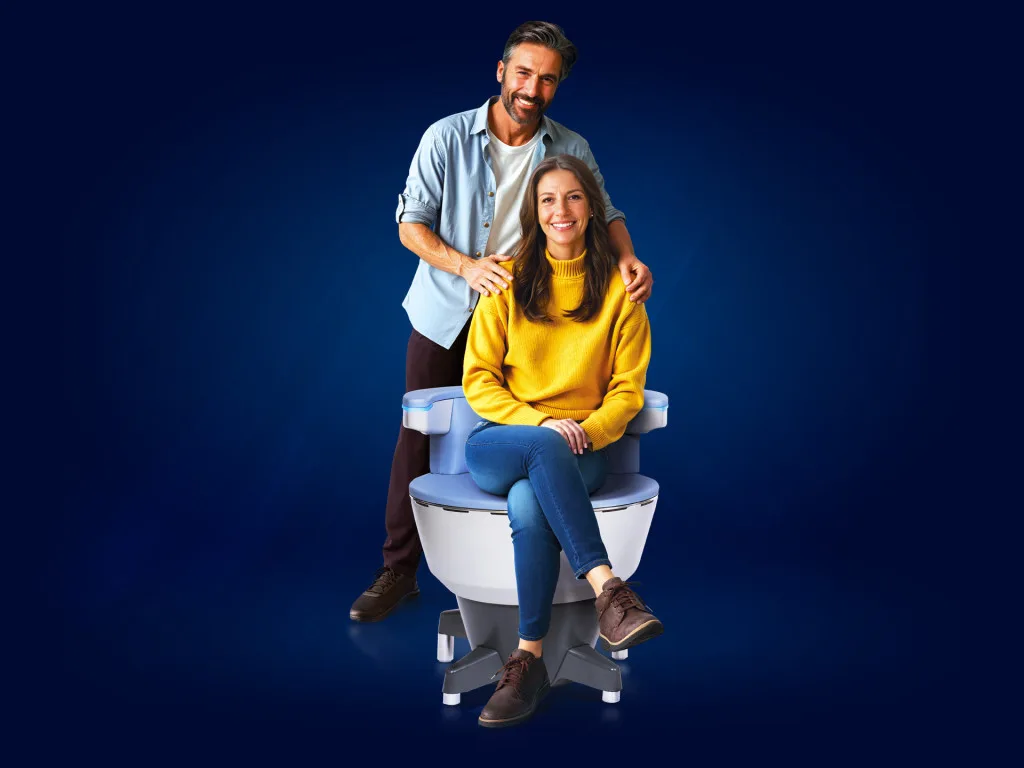
Stress urinary incontinence (SUI) occurs when physical movement or activity puts pressure on your bladder that exceeds the closing force of your urethral sphincter. The root cause is almost always pelvic floor muscle weakness. During activities like coughing, sneezing, laughing, jumping, or heavy lifting, your abdominal cavity generates a sudden spike in pressure. A healthy pelvic floor reflexively contracts to keep the urethra sealed. When those muscles are weakened, by childbirth (especially vaginal delivery), hormonal changes during menopause, chronic coughing, obesity, or simply aging. They can't generate enough counter-pressure, and urine escapes. Stress incontinence is the most common type of urinary incontinence in women under 60 and frequently begins or worsens during perimenopause. It affects an estimated 1 in 3 women at some point in their lives.
Stress incontinence has a direct line to your freedom of movement. Running becomes risky. Jumping rope or trampoline fitness classes are out of the question. You hold back during a good laugh. You brace yourself before every sneeze. High-impact sports, heavy lifting, and even yoga poses that engage your core can trigger episodes. Over time, many people unconsciously redesign their exercise routines and social activities around their incontinence, avoiding situations where leakage might occur rather than addressing the underlying muscle weakness.
"If any of this sounds familiar, you're not alone, and you don't have to keep adapting your life around it. There's a real, non-invasive solution."
First-line treatment for stress incontinence is typically pelvic floor muscle training (kegel exercises), often guided by a physical therapist. While effective for mild cases, many patients struggle to perform kegels correctly or consistently enough to see significant improvement. Pessary devices can provide mechanical support but require fitting and maintenance. Surgical sling procedures are highly effective but invasive, with potential complications. Emsella provides a non-surgical, non-invasive alternative that addresses the root cause: pelvic floor muscle weakness. By delivering 11,000 supramaximal contractions per session, Emsella strengthens the entire pelvic floor musculature at an intensity impossible through voluntary exercise. The contractions re-educate the neuromuscular pathways that control urethral closure, restoring the reflexive support that prevents stress-related leakage.
Stress incontinence is a failure of the urethral closure mechanism, specifically, a failure of the pelvic floor muscles to generate rapid, reflexive contractions strong enough to clamp the urethra shut when intra-abdominal pressure spikes (during a cough, sneeze, jump, or heavy lift). Effective urethral closure requires both types of skeletal muscle fibers: fast-twitch (Type II) fibers that generate the rapid, powerful contractions needed for immediate closure, and slow-twitch (Type I) fibers that maintain sustained baseline tone to keep the urethra sealed at rest. In stress incontinence, both fiber types have typically degraded, fast-twitch fibers have atrophied from disuse, and slow-twitch fibers have lost their tonic contractile capacity. Emsella's HIFEM protocol addresses both fiber populations through varied contraction patterns. The treatment cycle alternates between high-frequency bursts (which preferentially recruit and strengthen fast-twitch fibers) and sustained contractions (which target slow-twitch endurance fibers). This dual-pattern stimulation mirrors the physiological demands of actual urethral closure: you need fast-twitch fibers to slam the urethra shut in the milliseconds before a cough generates peak abdominal pressure, and you need slow-twitch fibers to maintain resting closure between events. Over six sessions, the supramaximal contractions force both fiber populations through progressive overload, the same stimulus that drives muscle adaptation in strength training, but at an intensity and comprehensiveness impossible to achieve through voluntary kegel exercises. The result is a pelvic floor that can generate faster, stronger reflex closure responses while maintaining higher baseline tone, addressing the two biomechanical failures that define stress incontinence.
Clinical Data Point
Published studies report that 75% of treated patients reduced pad usage by at least 50%, with improvement in both reflexive closure speed and resting pelvic floor tone, measured by perineometry and validated quality-of-life questionnaires.
Nobody should have to sit through a consultation to learn the price. The ranges below are typical for the Boston area. Ask for our exact pricing with the short form and we will send it the same business day, no appointment required.
Typical ranges are what Boston-area providers commonly charge, not a quote from us. Our own pricing is confirmed in writing when you ask below or at your free consultation.
Two fields. No appointment, no call unless you ask for one.
Prefer to talk? Call (617) 494-1166 or book a free consultation.
From your first consultation to visible results, here's exactly what to expect.
Your consultation will include a confidential discussion about the activities that trigger your leakage, how long you've been experiencing symptoms, and what treatments you've tried. Dr. Bromberg's team will help you understand the specific type of incontinence you're dealing with and explain how Emsella targets the root cause.
You remain fully clothed and simply sit on the Emsella chair. The 28-minute session delivers thousands of pelvic floor contractions through electromagnetic stimulation. You'll feel a strong contraction sensation in your pelvic floor, like an extremely intense kegel you could never generate on your own. The intensity is adjustable and the treatment is not painful.
Improvement is often noticeable within the first few sessions. Patients report fewer leakage episodes, greater confidence during physical activity, and reduced dependence on pads or protective garments. The full 6-session protocol delivers optimal strengthening. Many patients describe the moment they sneeze without bracing, or return to a favorite exercise, as genuinely life-changing.
If you answer "yes" to two or more of these questions, you may be a strong candidate for treatment.
Do you leak urine during specific physical activities like coughing, sneezing, laughing, or running?
Have you modified your exercise routine to avoid high-impact movements because of leakage?
Do you cross your legs or brace yourself before coughing or sneezing?
Have you tried kegel exercises without seeing meaningful improvement?
Is the fear of leakage preventing you from fully participating in activities you enjoy?
Free consultation. No obligation. Confidential.
Dr. Bromberg approaches stress incontinence as the medical condition it is, not an embarrassing secret to manage, but a treatable muscle weakness that responds to the right intervention. His 40+ years of clinical experience ensure that every Emsella treatment is medically supervised with your safety and dignity as the top priorities.
Bromberg Wellness is a division of Bromberg Chiropractic, a Cambridge medical practice trusted since the 1980s. Not a med spa. Not an aesthetician-led clinic. A doctor's office with four decades of clinical standards.
Book Free Consultation →"After six Emsella sessions, I can laugh, sneeze, and exercise without worrying. It genuinely changed my daily life. I wish I had done it sooner."
Stress incontinence, age 58
"Emsella is a life changer. It gave me more confidence, and I don't feel like I have to prepare for an emergency every time I leave the house."
Bladder leakage, age 52
"I had increasing incontinence after prostate treatment, and medication wasn't helping. After Emsella, my muscles are much stronger. I would recommend it to anyone."
Post-prostate incontinence, age 64
* Individual results may vary. Testimonials reflect personal experiences.
What a session feels like, who is and is not a candidate, pricing, and the questions patients ask most.
See the treatment →201 Broadway, First Floor, Cambridge, MA 02139. Red Line to Kendall/MIT, then about a 12-minute walk. Street parking on Broadway, plus the Green Street Garage nearby.
Address, hours and directions →Stress incontinence is caused by weakened pelvic floor muscles, often due to pregnancy, childbirth, menopause, aging, or surgery. When these muscles can't adequately support the bladder, any abdominal pressure causes leakage.
Clinical studies show that 95% of patients report significant improvement in quality of life after Emsella treatment, with many patients reducing or eliminating pad usage entirely.
Emsella delivers 11,000 supramaximal contractions per session, engaging the entire pelvic floor far more completely than voluntary kegel exercises, which only activate a subset of muscles.
Many patients notice improvement after just 2-3 sessions. Optimal results develop over the full six-session treatment course and continue to improve for weeks after.
After the initial six-session protocol, maintenance sessions (typically twice a year) help sustain your results long-term.
Schedule a free, confidential consultation with Dr. Bromberg's team. We'll assess whether Emsella is the right solution for you, no obligation, no pressure, just honest guidance.
Or call us directly:
(617) 494-1166📍 Visit us at
201 Broadway, First Floor, Cambridge, MA 02139
Bromberg Wellness, a division of Bromberg Chiropractic
Free, confidential, no-obligation. Dr. Bromberg's team will reach out within 24 hours.